Which Part of Beef Is More Tendon
Meat Scientific discipline and Nutrition
Composition of Meat
Meat muscle, which is what nosotros eat, is made of , bound together with connective tissue, that are mainly linked to other groups of muscles or directly to the creature'due south bone construction. Musculus contains 60% to 70% moisture, x% to 20% protein, 2% to 22% fat, and one% ash, depending on blazon and species.
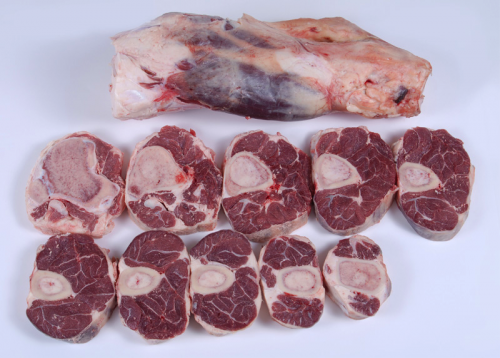
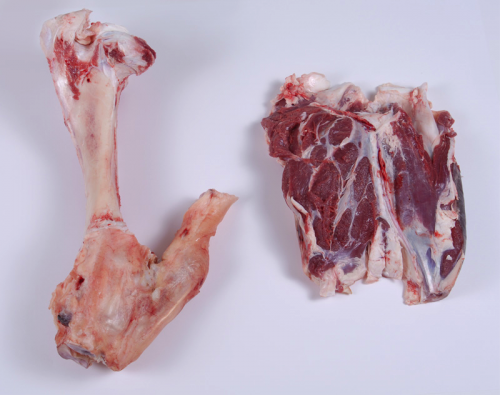
On larger bones (such every bit the shanks of larger animals), it is easy to run across the muscle groups in bundles (if cut on the cross-department) surrounded past fibres and a much heavier connective tissue () that forms a thin covering (called ) separating muscle groups or a at the ends of the muscle group (Figure 1). The tendon is attached to the bone at or near a bone joint (Figure 2).
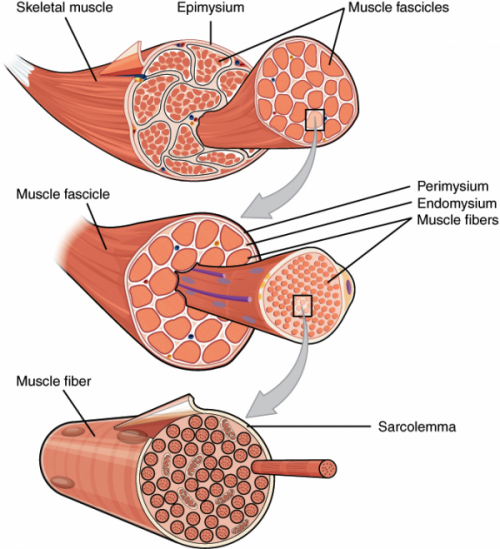
The muscle fibres are known as , which are composed of thick and thin filaments bundled in a repeating blueprint alongside the other myofibrils (Figure three). One unit of a bundle is called a , or little muscle. The thick filaments are the contractile protein . The thin filaments, known as , contain two other proteins called and that help regulate muscle contraction.
The amount of connective tissue in meats and its (the degree to which it is dissolved during the cooking process) can directly influence the tenderness of meat musculus. For instance, equally an animal ages, it has more connective tissue and therefore experiences , an increment in connective tissue that becomes highly insoluble. This is why older animals are usually tougher and younger animals are more tender.
The nearly tender cuts from a beef animate being, such as tenderloin, strip loin, and top sirloin from the beef hind quarter, tin can be prepared using a . In dissimilarity, tougher cuts from the front quarter of beef that have more than collagen connective tissue, such equally the blade, shoulder, and shank, crave a or , which breaks downwardly collagen into a form when cooked in water at temperatures of over 80°C (176°F). The collagen dissolves in the water, which is why stocks made from animal bones and connective tissue have torso and thicken when cooled. (We discuss cooking potential and tenderness in more particular later in the book.)
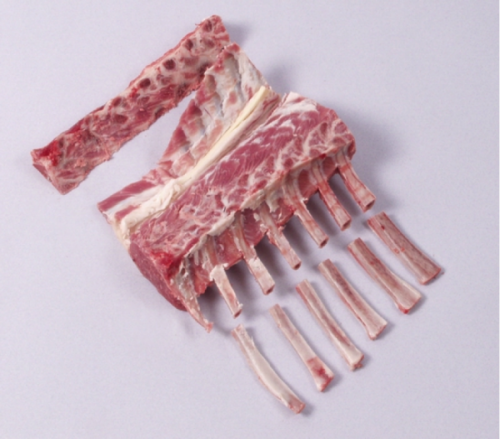
Heavy collagen, such as tendons at the ends of muscle groups and the protein elastin, does not interruption downward under this cooking process and is therefore insoluble in water. In addition to silverskin and tendons, there is a specific piece of heavy collagen (besides known as the ) that is yellow in color and located along the upper backbone from the base of the skull to the end of the rib cage in all meat animals (Figure 4).
Fats are deposited all over sure parts of the brute and contribute to the shelf life, flavor, and colour of dry out aged meats. Fat in beef meat musculus is called intramuscular fatty and appears every bit a blueprint of wavy lines, normally known as marbling (Figure five).
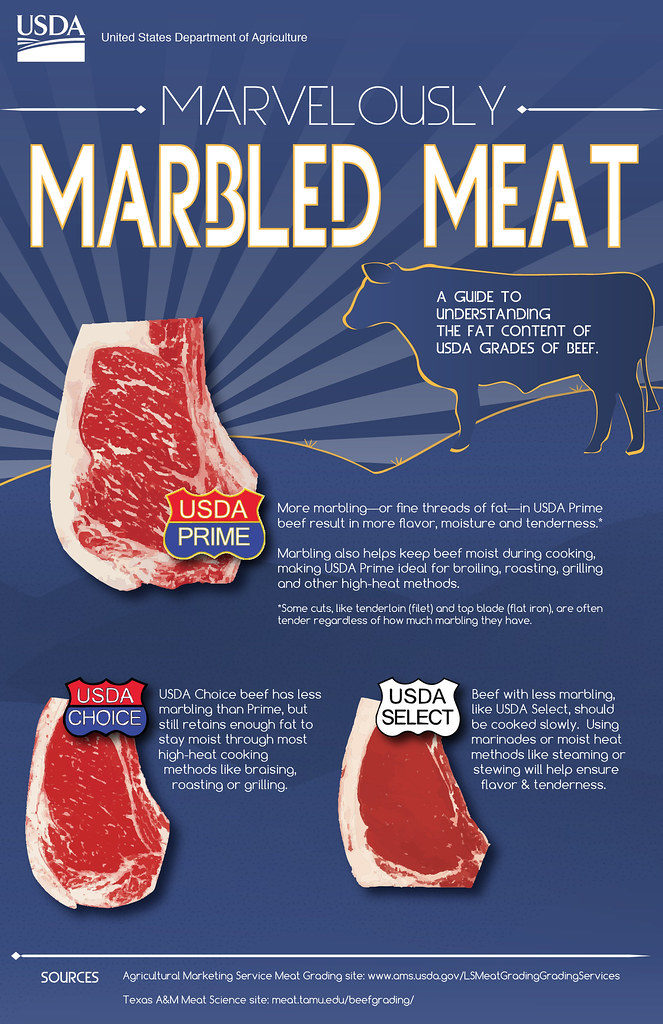
Well-marbled meat normally indicates that the cooked meat volition be juicy and tender, and the amount of marbling is a factor that is used to determine the class of beef, specifically for the A grades. Beefiness grading is discussed in detail later in the book.
Image descriptions
Figure 5. Poster indicating marbling in USDA Beefiness grades.
A guide to understanding the fat content of USDA grades of beef.
- USDA Prime: More than marbling—or fine threads of fat—in USDA Prime number beef result in more flavor, wet and tenderness. Marbling also helps proceed beef moist during cooking, making USDA Prime ideal for broiling, roasting, grilling and other loftier-heat methods. Some cuts. like tenderloin (filet) crd top uade (flat iron). cre frequently tender regardless of how much marbling they have.
- USDA Choice: USDA Choice beefiness has less marbling than Prime number, but still retains enough fat to stay moist through most loftier-heat cooking methods like braising, roasting or grilling.
- USDA Select: Beef with less marbling, similar USDA Select, should be cooked slowly. Using marinades or moist estrus methods like steaming or stewing will help ensure flavor & tenderness.
Return to Figure 5
Source: https://opentextbc.ca/meatcutting/chapter/composition-of-meat/

Post a Comment for "Which Part of Beef Is More Tendon"