Pushkin Museum of Fine Arts Moscow Evgeny Gavrilov 1993 Purchase Book
The early history of Portrait of a Gentleman with a Tall Hat and Gloves and 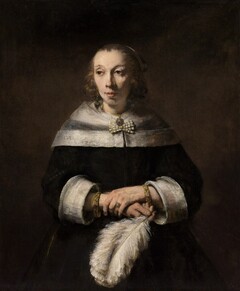 [fig. ane] Rembrandt van Rijn, Portrait of a Lady with an Ostrich-Feather Fan, c. 1656/1658, oil on canvas transferred to sail, National Gallery of Art, Washington, Widener Collection, 1942.9.68
This entry text was written for the pair of paintings
Heinrich Christoph von Reimers, Leningrad, am Ende seines Ersten Jahrhunderts, ii vols. (Saint Petersburg, 1805), 2:373.
Frederick R. Andresen, through his colleague Evgeny Maksakov, kindly provided the NGA library with a photocopy of this catalogue (Musée du Prince Youssoupoff [Saint Petersburg, 1839]). See also: Oleg Yakovlevich Neverov, Bang-up Private Collections of Royal Russia (New York and Leningrad, 2004), 89–98.
Gustav Friedrich Waagen, Die Gemäldesammlung in der kaiserlichen Ermitage zu Saint petersburg nebst Bemerkungen über andere dortige Kunstsammlungen (Munich, 1864), 414: "Ein männliches und ein weibliches Bildniss, fast Kniestücke. Pendants. Von ausserordentlicher Energie. Der kühle Ton der Lichter, wie der Schatten. die sehr breite Behandlung, beweisen, dass diese Bilder der spateren Zeit angehören." The Rembrandt paintings were not mentioned in Louis Viardot, Les musées d'Allemagne et de Russie (Paris, 1844); still, equally Viardot only listed a few works, many of which were the same equally those discussed past Waagen some twenty years later (see Gustav Friedrich Waagen, Die Gemäldesammlung in der kaiserlichen Ermitage zu St. Petersburg nebst Bemerkungen über andere dortige Kunstsammlungen [Munich, 1864]), one wonders if he saw the total drove. Co-ordinate to later on reports, the family had ever been quite reluctant to show off their treasures, so it is possible that Viardot was not given access to them. An article on Joseph Widener's acquisition of the paintings (American Art News 20 [December 10, 1921], 4) quoted a London Times article in which information technology was written that: "The gramps of the present Prince was a man of parsimonious disposition who guarded his picture gallery from all ordinary mortals and sightseers. At a ball given in the palace to the Royal Courtroom, Czar Alexander 3 wished to see the Rembrandts. Prince Youssoupoff (sic) personally conducted the czar and two Grand Dukes to encounter his gallery but kept out all other guests." Peter A. B. Widener (Joseph Widener's son, given his grandfather's proper noun), Without Drums (New York, 1940), 61, writes that the czar was allowed to see the drove just after he ordered Youssoupoff to unlock his pic gallery. Did the prince fear a request by the czar to transfer some of the paintings to the imperial collection at the Hermitage?
The paintings remained secluded and unavailable to nigh Americans and Europeans until they were shown at the great Rembrandt exhibition in Amsterdam in 1898. There they made a tremendous bear upon.
The London Times (September 15, 1898), for example, described "the immortal, unchanging interest" of these two portraits. See Catherine B. Scallen, Rembrandt, Reputation, and the Practice of Connoisseurship (Amsterdam, 2004), 136, who cites the comments of the art critic Jan Veth, who considered these portraits "true touchstones for questions of authenticity, with their cute execution and powerful chiaroscuro."
Roger Fry, "Review and Notices," The Burlington Mag 19 (September 1911): 353.
For those who had not had the opportunity to view the paintings in Amsterdam in 1898, engravings of the works in the commemorative book of that exhibition or in Dr. Wilhelm von Bode's monumental catalog of Rembrandt's paintings, published in 1902, provided splendid visual images.
Cornelis Hofstede de Groot, "Die Rembrandt-Ausstellungen zu Amsterdam (September–October 1898) und zu London (Jan–March 1899)," Repertorium für Kunstwissenschaft 22 (1899), nos. 34–35. Wilhelm von Bode assisted by Cornelis Hofstede de Groot, The Consummate Work of Rembrandt, trans. Florence Simmonds, 8 vols. (Paris, 1897–1906), 7: nos. 489–490. The loftier quality of the reproductions in Bode'south publication was remarked upon by Roger Fry in 1921 when he had the occasion to publish photographs of the paintings in his article, "Two Rembrandt Portraits," The Burlington Magazine 38 (May 1921): 210.
Peter A. B. Widener, Without Drums (New York, 1940), 60–64. The date of Widener's purported trip is not known. His grandson writes that he went to Russian federation "around the turn of the century." According to Dr. Ronald Moe (author of Prelude to the Revolution: The Murder of Rasputin [Chula Vista, CA, 2011]), a more probable appointment is 1909, the year the Kiel Canal opened, which would have provided access to Petrograd for Widener's yacht Josephine. In that year also the paintings were on public exhibition in Petrograd for the first fourth dimension since existence lent to Amsterdam in 1898. The "Prince Yusupov" with whom the negotiations were carried out during those years was Felix, count Sumarokov-Elston (1856–1928), hubby of Princess Zinaide Yusupova, the concluding surviving representative of the Yusupov family. He was given the right to accept his wife's proper noun and title, but the art collection was actually hers.
Peter A. B. Widener had not as yet developed into the remarkable collector of Rembrandt paintings he was to become, but it was clear that these works made a lasting impression on him. Later having been rebuffed by Yusupov, Widener turned to his London dealer, Arthur J. Sulley, to enquire him to find a style to convince the prince to part with his treasures. On April 7, 1911, Sulley wrote to Widener saying that he would try to approach Yusupov in the same way that he had approached the Marquis of Lansdowne apropos Rembrandt's The Manufacturing plant: "That is to say that my friend is getting an introduction to the owner from ane of his personal friends, and is trying to become him to name a toll. If the owner volition non name whatsoever price, I propose (if you concord) to offer him one million rubles, which is about £100,000."
Letter in NGA curatorial files.
Letter of the alphabet in NGA curatorial files. Sulley may indeed accept traveled to Petrograd to endeavour to arrange for the purchase prior to the start of World State of war I in 1914. An article in American Art News xx (December 17, 1921), four, says that "the belatedly P. A. B. Widener earlier the war sent an emissary to Russia and bundled for their buy, the toll being $500,000. Prince Youssoupoff backed out of the deal by cable, after the emissary had returned to England."
Although the attraction of Widener's money did not in and of itself convince Prince Yusupov to sell his paintings, these offers clearly pointed out to him the immense value collectors placed upon his two Rembrandt portraits. Thus, when the Russian Revolution forced the Prince'south family to leave Russia, his son, Prince Felix Felixovich Yusupov (1887–1967), took with him, among other personal possessions and family jewels, the two Rembrandt paintings.
Felix Felixovich, according to Dr. Moe, was a student at Oxford from 1909 to 1912. He was not given the championship Prince Yusupov until 1914.
According to Dr. Moe and Dr. Idris R. Traylor (who, before his decease, was researching the Yusupov family for a planned book), the Yusupov family sailed from Yalta in the Crimea on the British warship Marlborough, which had been sent past Male monarch George V to accept his aunt, the Dowager Empress Maria Federovna, to London in April 1919. Yusupov and his wife disembarked in Republic of malta and traveled via Brindisi and Paris to London. The report by Sir Francis Pridham, a British naval officer who participated in the evacuation (Shut of a Dynasty [London, 1956]), includes a photograph of young Felix Yusupov aboard the Marlborough. Contemporary reports about Yusupov's escape from Russia, however, raise the possibility that he may have dramatized the circumstances of his flight. Charles John Holmes, Self and Partners (Mostly Cocky): Being the Reminiscences of C. J. Holmes (New York, 1936), 376, writes, for example: "In 1919 Prince Youssoupoff suddenly appeared with his ii famous Rembrandt portraits, still concealed by the 'Modernist' canvases under which he had contrived to bring them out of Russian federation. Thrilling equally was his account of the death of Rasputin, the story of his own escape, in the disguise of an art student, with the family jewels swathed around his body in long, painful bondage, was no less vivid. Trying indeed must the moment have been when a kommissar, much interested in the arts, took a fancy to ane of the Prince'southward first experiments in painting, and wanted to buy it, in ignorance of the fact that it covered a Rembrandt masterpiece." Variants of this story appeared in news reports in 1921 (see NGA curatorial files). The artist who painted over the 2 Rembrandt paintings was a friend of Yusupov, Gleb W. Derujinsky, who later immigrated to the United States and became a successful sculptor. I would like to thank Andrea Derujinsky for providing me with biographical information about her grandfather and his relationship to Yusupov (personal communication, July 2013).
In the fall of 1920, Joseph Due east. Widener (a collector in his ain correct, besides as caretaker of his father's drove) received a letter from a Mr. Harold Hartley offering him Yusupov's paintings for £210,000. Hartley indicated that the prince preferred to sell to an "approved heir-apparent" rather than to a dealer, and also mentioned that the "Prince considers both paintings far superior to 'The Mill' and of greater value."
Letter, Oct 20, 1920, in NGA curatorial files.
Letter in NGA curatorial files.
Joseph Widener arrived in London during the summer of 1921 and examined the paintings in a bank vault where they were being kept equally collateral for a loan to the prince. Perhaps totally in expert faith, or perchance as a way to purchase the paintings for a lower price, Widener offered to pay the prince £100,000 with the stipulation that Yusupov could repurchase them within three years at eight percent interest should his fiscal state of affairs improve to the betoken where he could once over again "keep and personally enjoy these wonderful works of fine art."
Samuel N. Behrman, Duveen (New York, 1952), 18 (besides 1972 ed., 16). According to Dr. Moe, Behrman's implication that Yusupov's reacquisition of the paintings was contingent upon a restoration of the quondam regime in Russia is inaccurate. A cable from Joseph Widener dated September 19, 1922, says that the purchase contract "provides that re-purchase tin can exist made only for Prince Youssoupoffs [sic] personal enjoyment of the pictures and that I am to receive satisfactory assurances and guarantees that pictures or title to same will not pass out of his possession for ten year period." The cable is in the Duveen Brothers records, accretion number 960015, Enquiry Library, Getty Research Institute, Los Angeles: reel 383, box 528, folder 4 (see as well copies in NGA curatorial files).
The story of Joseph Widener'south acquisition of these boggling paintings does not, even so, end with the events of 1921. Shortly after Widener acquired them, the collector Calouste Gulbenkian was told past the dealer Joseph Duveen that he had "but lost the ii best Rembrandts in the world to Widener. He bought them both for a hundred one thousand pounds, and each of them is worth that."
Samuel North. Behrman, Duveen (New York, 1952), 18 (also 1972 ed., 16).
Transcripts from the trial (kindly provided by Frederick Andresen) and copies of the newspaper coverage of information technology by the New York Times are in NGA curatorial files. Run across also Samuel N. Behrman, Duveen (New York, 1952), 22–24 (also 1972 ed., twenty); John Walker, Self-Portrait with Donors: Confessions of an Art Collector (Boston and Toronto, 1974), 244.
Neither painting appears to exist signed or dated, although Valentiner in his 1931 catalog of the Widener Collection noted that the portrait of the woman was signed, "Rembrandt f. 166' [the final effigy illegible]."
Pictures in the Collection of Joseph Widener at Lynnewood Hall, Elkins Park, Pennsylvania (Philadelphia, 1931), 74–77.
Wilhelm R. Valentiner, Rembrandt: wiedergefundene Gemälde (1910–1920), Klassiker der Kunst in Gesamtausgaben, 27 (Stuttgart and Berlin, 1921), 484–485.
Wilhelm R. Valentiner, Rembrandt Paintings in America (New York, 1931), nos. 171–172. Valentiner dates them "slightly later paintings dated 1662."
Abraham Bredius, Rembrandt, Schilderijen (Vienna, 1935), no. 327, fourteen note.
Kurt Bauch, Rembrandt Gemälde (Berlin, 1966), nos. 446 and 528, 23 note 446, 26 notation 528; Abraham Bredius, Rembrandt: The Consummate Edition of the Paintings, revised by Horst Gerson (London, 1969), 255, 313, 575 annotation 327, 582 note 402.
I exception to the consistently belatedly dates given the paintings since the 1930s occurred in the catalog of the Rembrandt exhibition at the National Gallery of Art in 1969. Hither it is noted that neither the costumes nor the painting techniques indicate such a late date for the works.
Rembrandt in the National Gallery of Fine art (Washington, 1969), 25. 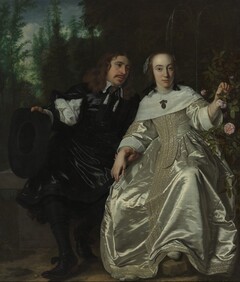 [fig. 2] Bartholomeus van der Helst, Abraham del Court and His Wife Maria de Kaersgieter, 1654, oil on sail, Museum Boijmans Van Beuningen, Rotterdam. Photo: Studio Tromp, Rotterdam
See inventory no. C1477, Rijksmuseum, Amsterdam.
The hairstyle and costume of the homo are more than difficult to date than are those of the woman, partly considering the collar and cuffs have been contradistinct (see Technical Summary).
Pierre Paul von Weiner et al., Les anciennes écoles de peinture dans les palais et collections privées Russes (Brussels, 1910), 8, lament the damage that had occurred to the Yusupov paintings every bit a effect of poor restoration: "Cette collection est restée intacte, on plutôt seulement complète, car la restauration du professeur Prakhoff y causa tout récemment united nations dommage irréparable: united nations certain nombre de toiles . . . en a cruellement souffert." Egbert Haverkamp-Begemann (letter January eight, 1985, NGA curatorial files) has kindly provided information almost the twentieth-century restoration: "I spoke with C. F. Louis de Wild who checked his notes. The paintings were brought to his male parent's home past Duveen in 1922. His father was mortally sick at the fourth dimension, and only cleaned the man, with the help of his son (Louis), but did not retouch, inpaint or complete the restoration in whatsoever mode. Louis does non recollect what the painting looked like at the time. The adult female was non touched. What this means is that De Wild Sr. and Jr. started cleaning the man in 1922, then gave up because of personal circumstances. Neither he nor I know who did carry out the cleaning." 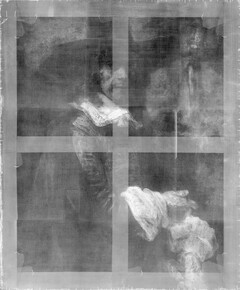 [fig. 3] X-radiograph composite, Rembrandt van Rijn, Portrait of a Gentleman with a Tall Chapeau and Gloves, c. 1656/1658, oil on canvass transferred to canvas, National Gallery of Art, Washington, Widener Collection, 1942.ix.67
The billowing cuffs are more elaborate than the normal apartment cuffs, simply they do resemble those seen in Bartholomeus van der Helst'due south Portrait of a Beau, 1655 (Toledo Museum of Fine art), inventory no. 76.12; run across The Toledo Museum of Art: European Paintings (Toledo, Ohio, 1976), 247, no. 101, repro.
Costume styles are usually only a rough measurement of date because old styles were frequently worn after new ones were introduced, especially by older and more than conservative people. These sitters, however, appear to exist in their belatedly thirties or early forties, and, judging from the woman's jewelry, wealthy. It seems unlikely that they would have had themselves portrayed in outmoded fashions, which, on the basis of costume analysis, would suggest a date for these portraits in the mid-to-late 1650s.
Stylistically, such a appointment for these paintings is also compatible with Rembrandt's other works. In no painting of his from the mid-1660s does one detect the careful modeling of the woman's hands and confront, the suggestions of texture as seen in her features, jewelry, and lace, or the broad planar way in which forms are illuminated by the low-cal. No hint of the palette pocketknife is to exist found in either work. Similarities of style and technique, withal, do be in paintings from the tardily 1650s, in particular betwixt the woman and Rembrandt's portrait of Catherine Hooghsaet, signed and dated 1657 (Penrhyn Castle, Wales).
Abraham Bredius, Rembrandt: The Complete Edition of the Paintings, revised past Horst Gerson (London, 1969), no. 391, repro.
The portrait of the human being is more boldly executed than that of the woman in that the modeling does not have the same restrained, planar quality. Brushstrokes on the man's face are broken and roughly juxtaposed as Rembrandt modeled his sharply illuminated features with sure strokes of varying tones of pinks and ochers. The boldness of Rembrandt's touch originally must have been even more than pronounced, for X-radiographs demonstrate that both of the man's cuffs and hands were more abstractly rendered than they now appear. The fact that the gloves held past the gentleman in his left manus are cut at the bottom edge of the composition suggests that the paintings were in one case slightly larger. I could imagine that the figures were initially situated in a more than spacious setting, which suggests that they have been trimmed on all sides. The dimensions of the pendant portraits in the Hoet sale of 1760 loosely correspond to the paintings' current sizes, so any reduction in size must accept occurred at an earlier date.
Gerard Hoet, Catalogus of naamlyst van schilderijen..., 2 vols. (The Hague, 1752), with supplement by Pieter Terwesten (1770) (reprint, Soest, 1976), iii:225, nos. 49 and 50, where they are described as being "hoog 39, breet 30 ½ duimen."
The bold manner with which Portrait of a Gentleman with a Tall Lid and Gloves is executed is related to Rembrandt's painting technique in male portraits of the late 1650s. In earlier portraits, such as January Half dozen, 1654 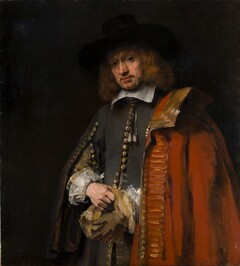 [fig. 4] Rembrandt van Rijn, January Six, 1654, oil on canvas, Six Drove, Amsterdam
 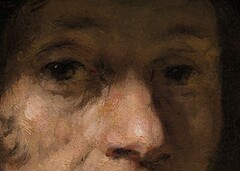 [fig. 5] Item of eyes, Rembrandt van Rijn, Portrait of a Gentleman with a Tall Hat and Gloves, c. 1656/1658, oil on canvas transferred to canvass, National Gallery of Art, Washington, Widener Collection, 1942.9.67
 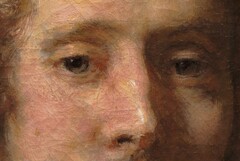 [fig. vi] Particular of eyes, Rembrandt van Rijn, A Young Man Seated at a Table (perhaps Govaert Flinck), c. 1660, oil on canvass, National Gallery of Fine art, Washington, Andrew W. Mellon Collection, 1937.1.77
An unusual technical feature reinforces the probability that Rembrandt executed these ii portraits in the late 1650s: they were both originally painted on a herringbone-weave canvas, a support Rembrandt is not known to have used before in his career. The paintings were removed from these supports and transferred onto finely woven canvases. Presumably, this transfer was fabricated in Russian federation in the nineteenth century.
Inscribed in Russian on the dorsum of the Portrait of a Gentleman with a Alpine Hat and Gloves is: "Painting transferred from an erstwhile sheet onto a new sheet. I. Sidorov." Translation kindly made past Dauphine Sloan.
There seems piddling question that these works were conceived as companion portraits. Not only were they together in the Yusupov collection by the outset of the nineteenth century, just the poses assumed by the figures are comparable to those in pendant paintings by other masters.
Come across inventory nos. 239, 240, Mauritshuis, The Hague. Discussed by Wheelock in Arthur Grand. Wheelock Jr. et al., Anthony van Dyck (Washington, 1990), 196–200.
See inventory no. 515, Rijksmuseum Twenthe, Enschede.
See inventory no. A3064, Rijksmuseum, Amsterdam. For both, see Rudolf E. O. Ekkart, Johannes Cornelisz. Verspronck (Haarlem, 1979), 158, no. 32, repro., 161, no. 33, repro.
The question that remains unanswered is the identity of the sitters. The circle of wealthy friends and acquaintances at that period of Rembrandt's life who might have ordered portraits was rather small. Valentiner's hypothesis that they represented Rembrandt's son Titus and his wife, Magdalena van Loo, has long since been rejected. A proffer past Dr. I. H. van Eeghen that they stand for Jacob Louysz Trip (1636–1664) and his wife, Margarita Hendricksdr Trip (1637–1711), is doubtful.
I. H. van Eeghen, "De familie Trip en het Trippenhuis," in Het Trippenhuis te Amsterdam (Amsterdam, Oxford, and New York, 1983), 71–73, 121 annotation 105.
Henriette Rahusen has suggested (personal communication, 2010) that the man bears bang-up similarity to Aernout van der Mye (c. 1625–1681), the 2d man from the left in Rembrandt'due south Syndics of the Cloth Drapers' Club (Rijksmuseum, Amsterdam, on loan from the city of Amsterdam, see the entry on
Arthur K. Wheelock Jr.
April 24, 2014
Source: https://www.nga.gov/collection/art-object-page.1206.html

Post a Comment for "Pushkin Museum of Fine Arts Moscow Evgeny Gavrilov 1993 Purchase Book"